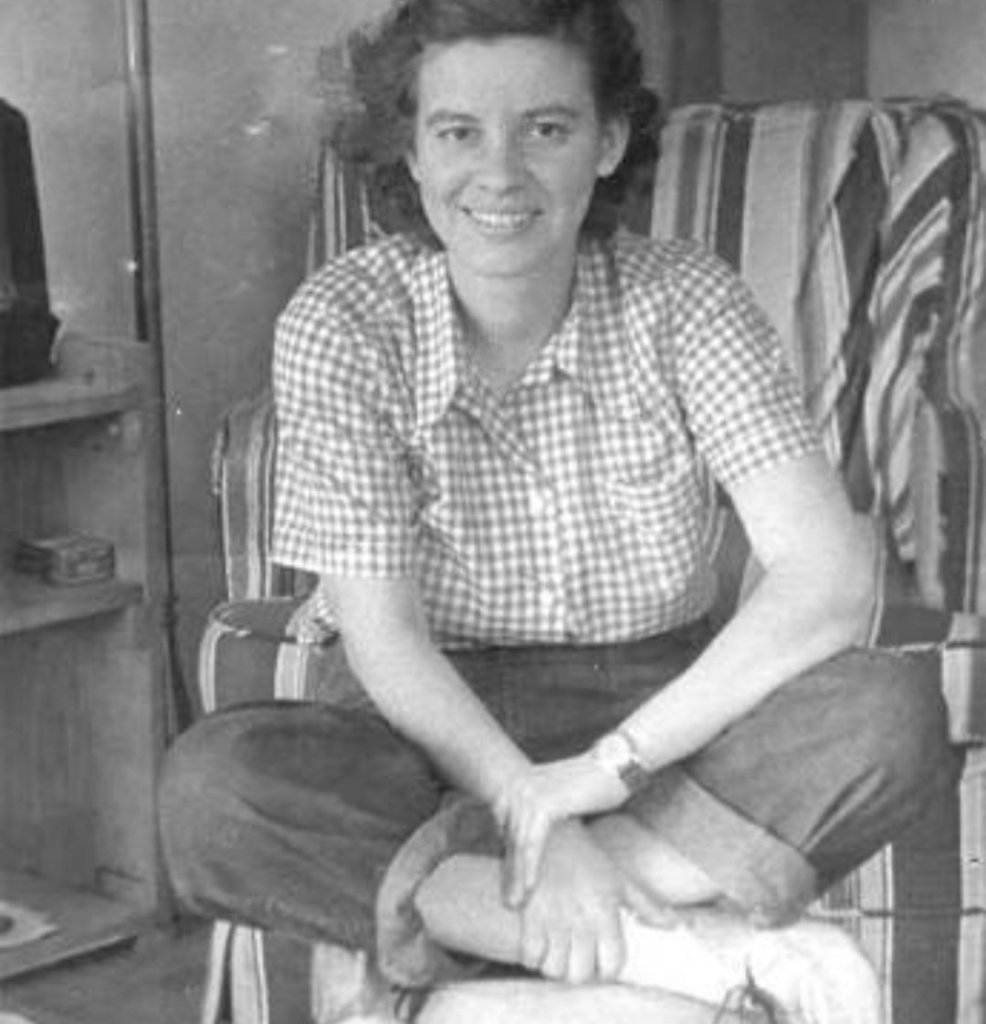
We remember personalities like Albert Einstein, Issac Newton, Alan Turing, and many more because they contributed a lot in the field of science and technology. What about females like Esther Lederberg?
The people only know the above great personalities no one talks about females and their contribution. Females usually are taken for granted. Same happened with Esther Lederberg, why is it that we barely know her name?
Esther Miriam Zimmer Lederberg was born on 18th December 1922 in The Bronx, New York, United States. Born as the oldest child to a poor Bronx family, her father was born in Sereth, Bukovina modern-day Romania, and opened a print shop in the Bronx. They were so poor that her school lunches consisted only of a single slice of bread with the juice of a tomato squeezed on top.
Lederberg’s dedication to her studies, curiosity, and willingness to challenge social norms make her one of the most brilliant women of the 20th century. She never let her financial bearings stop her from achieving what she wanted.
EDUCATION: BEGINNING OF DISCRIMINATION
She attended Evander Childs High School and graduated when she was only 16 due to her brilliance and intelligence. Then she went to Hunter College where she initially intended to study French and Literature but she studied biochemistry because of the horror of her professors. Unknown of her future achievements and the orthodox thinking her professors tried to convince her that a woman had no place in the scientific world but Lederberg pushed herself for the roles that females typically did not receive. She went on to receive a Masters in Genetics from Stanford University.
CAREER: HER DETERMINATION
She later began working as a research assistant at the Carnegie Institute of Washington. She worked with Alexander Hollaender and Milislav Demerec investigating the genetics of bacteria to make penicillin more effective. In 1944 she published her first paper, one of the few papers for which she received proper credit as a co-author. While working on UV and X-Ray mutations in the production of penicillin, she was awarded a fellowship at Stanford University.
Lederberg believed that her gender had nothing to do with what she could accomplish. Through this mindset, she was also working to dispel the common notion that women weren’t as capable as men.
Lederberg married Joshua Lederberg, a professor at the University of Wisconsin. She had to work twice as hard to be awarded the same privileges that the men in her field received so easily. Even with all of the hindrances she faced, Esther Lederberg left an indelible mark in the field of microbiology she was the first individual to isolate the bacterial virus lambda phage. Additionally, her observations of the bacteriophage in agar solution led to an understanding of specialized transduction. Another one of Lederberg’s discoveries was replica plating. While there were many existing ways to reproduce bacterial colonies, she found the most efficient method. Interestingly enough, it came from a very simple, but ingenious idea. Around the same time, Esther Lederberg made yet another significant discovery. She recognized the bacterial fertility factor (factor F) and its role in DNA replication. In the academic world, working with Joshua Lederberg was both a blessing and a curse for Esther Lederberg. Accessing labs through her husband opened doors that made many of her discoveries possible. As he was a senior researcher and professor, he had access to equipment that Esther Lederberg, as a woman, was not able to use. But that was where the benefits stopped. As long as she was Mrs. Lederberg, Esther’s success in science would be credited to her husband.
She lived in an environment where women were expected to live in the shadow of their husbands.
Joshua Lederberg did not give Esther Lederberg the acknowledgment she deserved. When Joshua Lederberg won the Nobel Prize for the work he and his wife had done together, including replica plating as well the bacterial fertility factor F, her name was not mentioned once in the prize. Joshua Lederberg admitted that his wife did deserve recognition for her contributions: yet he did not include her in any of his acceptance speeches. This unjust treatment would continue throughout all of Esther Lederberg’s career.
All these things show how Esther compromised in her life without receiving any sought of credit but she gave her best to contribute to society. We should have proud of the females of the world who contributed not for appreciation but development.
There has been a lot of contribution from women in STEM for many years but they haven’t received enough recognition and awards for their work but we feel very honored to say that the time has changed from the last few years and women are getting their share of appreciation and respect for their impactful work, some of them are mentioned above.
Women have increasingly taken top positions and strived for more advancement.
There is certainly much room for more contributions, but we can look forward confidently to the future, secure in the knowledge that women all over the world are striving for betterment and contributing their part. These eminent women of all time act as role models for the younger generation to contribute more and give power to each one of us on the occasion of “Women’s Equality Day”.
“ The time is long overdue to encourage more women to dream the possible dream”. – Sheryl Sandberg, COO of Facebook
By Aishwarya Gupta

 Let's Make A Difference
I believe women have the strongest mindset over any animal/species on earth, and I’m not just saying that because I am a woman ; )
I love reading inspiring stories/biographies!
LikeLiked by 1 person
you can find more inspiring and motivating things on my website
LikeLike
Women face so much in life that we can never imagine. Providing them highlight and appreciating their work is the best we can do
LikeLike
Wow! She sounds like she was an incredible lady!
LikeLiked by 1 person
She was one!
LikeLike
This is an amazingly powerful sorry! Thanks for giving her the recognition she deserves 👏🏾💖
LikeLiked by 1 person
Absolutely
LikeLike
I wish more people would be recognized for their contributions.
LikeLiked by 1 person
share this blog post with as many people you can to provide her a recognition
LikeLike
🔥🔥🔥
LikeLiked by 1 person